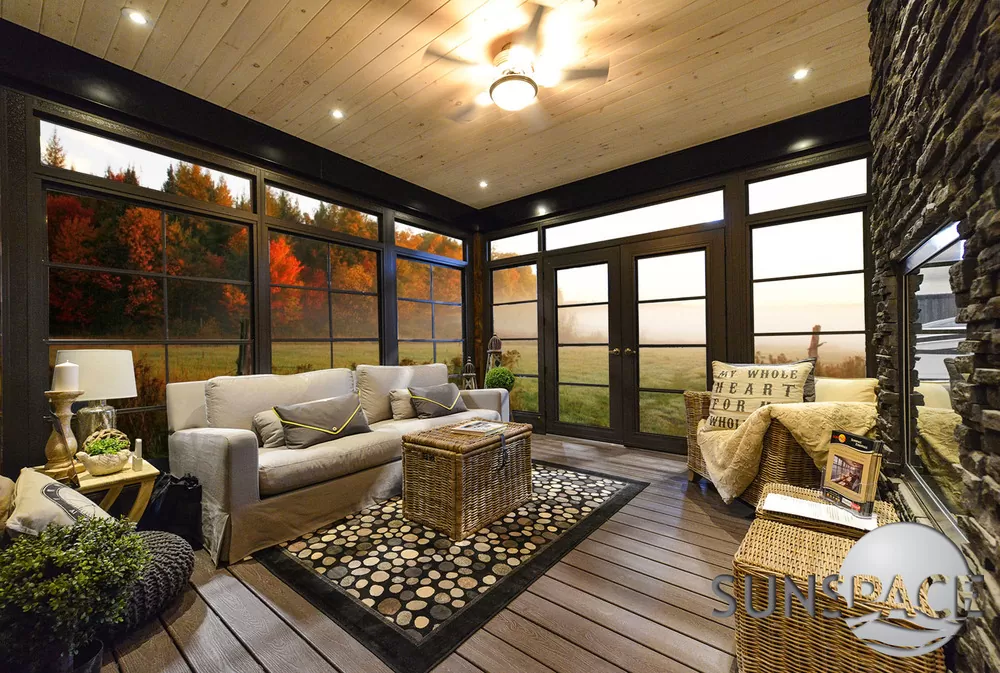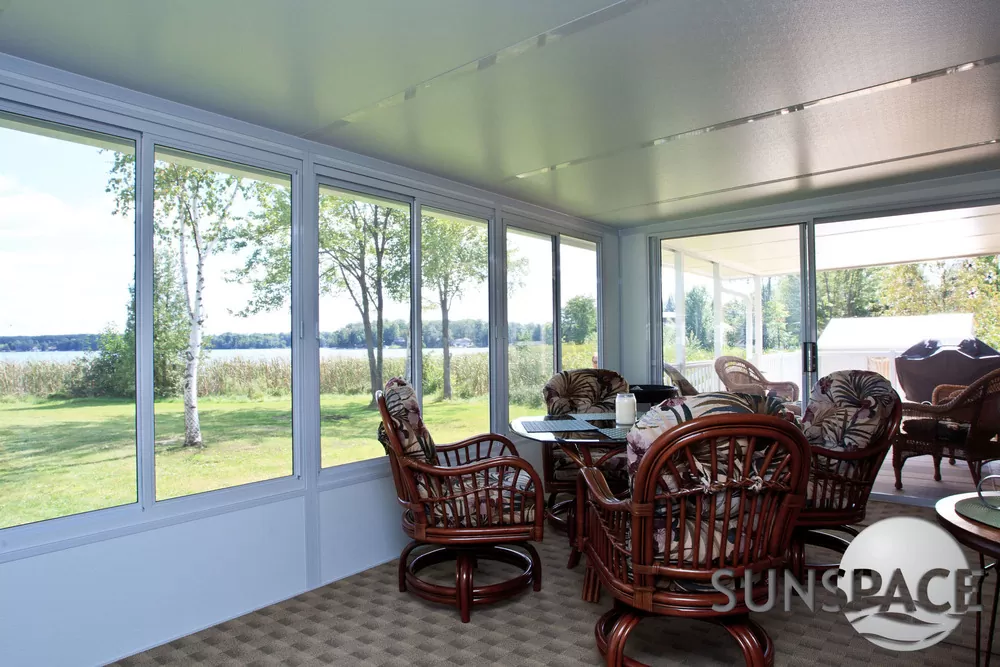
Jersey Shore homeowners usually want the same outcome: a brighter space you will actually use, without the weather shutting it down. Pricing is tricky because the “3-season vs 4-season” label determines what gets built, what gets permitted, and what gets added for comfort.
This post breaks down typical price ranges, the main cost drivers, and a simple way to compare quotes so you can budget with fewer surprises.
If you’re talking to a Sunroom builder in Jersey Shore, ask for an itemized scope up front so you are not comparing totals that include different features.
Quick Answer With Typical Price Ranges
A 4-season sunroom costs more because it is built for year-round comfort with insulation and heating and cooling, while a 3-season room is built for milder months.
For total project cost, Angi lists $10,000 to $40,000 for a 3-season sunroom and $25,000 to $80,000 for a 4-season sunroom.
HomeAdvisor shows a similar 3-season range of $10,000 to $40,000, and it lists 4-season rooms at $25,000 to $120,000.
For cost per square foot, HomeAdvisor places many sunroom builds around $150 to $300 per square foot.
HomeGuide estimates about $80 to $230 per square foot for a custom 3-season room and about $200 to $400 per square foot for a custom 4-season sunroom.
| Category | 3 Season Sunroom | 4 Season Sunroom |
| Typical total cost range | $10,000 to $40,000 (Angi, HomeAdvisor) | $25,000 to $80,000 (Angi) and up to $120,000 (HomeAdvisor) |
| Typical cost per square foot | Often within $150 to $300 per sq ft, depending on scope (HomeAdvisor) | Often within $150 to $300 per sq ft, depending on scope (HomeAdvisor) |
| Why is the price different | Simpler comfort needs and lighter build scope | Insulation, higher-performance windows, plus heating and cooling |
Use these ranges for early budgeting, then expect site conditions and scope details to set the final number.
Why 4 Season Sunrooms Usually Cost More
The cost gap arises because a 4-season room must manage temperature and moisture year-round, requiring higher-performance materials and more systems.
Angi notes that 3-season rooms often have minimal insulation and may use single-pane windows, which limit winter comfort.
Angi also describes 4-season sunrooms as built for year-round use with better insulation, double or triple-pane windows, and their own heating and cooling systems.
That difference changes several budget lines at once.
- Windows and doors: Better glass packages and tighter frames tend to cost more.
- Insulation and air sealing: More insulation and more detailed work increase labor and materials costs.
- Heating and cooling: A dedicated HVAC plan or tie-in adds equipment and trade coordination.
- Permits and timeline: Every addition requires a permit, and permitting can affect the schedule and planning.
Jersey Shore Factors That Shift The Budget
Even at the same size, coastal projects can be priced differently because the starting structure and site exposure change the build approach.
If you can enclose an existing porch, patio, or deck, it can be cheaper than building a brand new addition.
Fixr breaks this down as “conversion” versus “addition,” with conversions averaging about $80 to $200 per square foot and additions averaging about $130 to $300 per square foot.
Glass is another major driver, especially in rooms with many windows.
Fixr notes that glass can make up as much as 90% of a new sunroom, depending on the design.
Finally, do not overlook the basic structural work.
If the existing deck, patio, or foundation needs reinforcement or site prep, HomeAdvisor notes that clearing and preparing the site can add $500 to $5,600, and related work like excavation can add more.
Cost By Size And Use Case
Square foot pricing helps, but your use case matters more. A lower-priced room is not a deal if it cannot stay comfortable for the months you plan to use it.
If you mainly want spring through fall use, a 3-season room can be the value pick.
If you want actual indoor use in winter, a 4-season room is usually the right match, and the budget needs to reflect insulation and HVAC.
To sanity check totals by size, HomeAdvisor publishes average cost ranges for standard footprints, including 12×20 at $36,000 to $72,000 and 20×20 at $60,000 to $120,000.
Those size ranges are not “3 season vs 4 season” by themselves, but they are helpful in spotting quotes that look off for the square footage.
How To Compare Quotes Without Overpaying
Big price swings usually occur because two “4-season” quotes do not specify the same build.
So your goal is to force clarity in writing before you compare totals.
Ask each contractor to answer these questions in the proposal.
- What makes this a 3-season or 4-season in your scope, including insulation, window type, and heating and cooling plans?
- What is included for foundation and roof tie-in, and what assumptions are being made about the existing structure?
- What permits are included, and what is the expected approval timeline?
Then compare the big drivers line by line, since that is where the fundamental differences hide.
- Windows and doors: performance level and number of openings.
- Insulation and air sealing: what surfaces are insulated and how drafts are handled.
- HVAC: what system is included and who installs it.
- Electrical and finishes: lighting, outlets, flooring, and trim.
If one total is far lower, it often means a major item is missing, or the room is being defined differently.
FAQs
How much more does a 4-season sunroom cost than a 3-season?
Angi lists 3-season sunrooms at $10,000 to $40,000 and 4-season sunrooms at $25,000 to $80,000.
HomeAdvisor lists 3-season rooms at $10,000 to $40,000 and 4-season rooms at $25,000 to $120,000.
What is the cost per square foot for a sunroom?
HomeAdvisor estimates $150 to $300 per square foot for a sunroom.
Fixr also provides per-square-foot ranges, including $80 to $200 for conversions and $130 to $300 for additions.
Do 3-season sunrooms need HVAC?
Usually no, because 3-season rooms are built for milder weather and often have minimal insulation.
Is enclosing an existing porch cheaper than building a new one?
Often, yes. Conversion projects are generally less expensive than building an addition from scratch.
What do permits cost, and how long can they take?
HomeAdvisor states that building permits typically cost $250 to $1,500 and that the process can take 4 to 8 weeks.
Can I convert a 3-season room into a 4-season room later, and what does it cost?
Fixr estimates converting a three-season sunroom into a four-season sunroom at $5,000 to $20,000, depending on upgrades such as insulation, windows, HVAC, and, in some cases, foundation work.
Get A Real Number For Your Home
If you want a reliable budget, the fastest step is an itemized estimate based on your home’s structure, orientation, and how many months you expect to use the room. Contact Sunspace of the Jersey Shore to discuss 3-season vs. 4-season options and what should be included in bids, so you can compare quotes with confidence.